
Currently Empty: $0.00
November 15, 2025
0 Comments
When searching for a replacement battery for a Philips HeartStart AED, you’ll quickly notice two options that look almost identical:
-
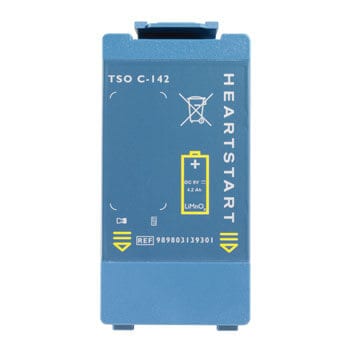
Philips Aviation AED Battery (also known as the “TSO-approved” aviation version)
Both fit the same AED units, and both deliver long standby life — so why does one cost more, and do you really need it?
This guide explains the true difference in plain English and helps you decide which one is right for your AED.
Quick Summary
| If your AED is… | You should choose… |
|---|---|
| Located in a school, business, gym, public building, factory, or home | Philips M5070A Standard Battery |
| Installed on an aircraft as emergency medical equipment | Philips Aviation AED Battery (TSO-approved) |
Technically, both batteries deliver similar energy, life span, and performance — the big difference is aviation certification, not capability.
What the Philips M5070A Standard Battery Is Designed For
The Philips M5070A is the standard OEM battery used in:
-
Philips HeartStart OnSite (HS1)
-
Philips HeartStart Home AED
-
Philips HeartStart FRx AED
Key details:
-
~ 200+ shocks or about 4 hours of operating time
-
~ 4-year installed standby life
-
~ 5-year shelf life (based on the “install-by” date)
-
Supports automated self-tests and readiness alerts
This is the battery used in most public access AED programs in the United States, including:
-
Schools & universities
-
Gyms & sports facilities
-
Manufacturing sites & warehouses
-
Office buildings & retail spaces
-
Churches & community centers
-
Residential & home AED owners
If your AED is used on the ground:
👉 The Philips M5070A is the correct and cost-effective option.
What Makes the Aviation AED Battery Different
The aviation battery is designed for the same AED models, but carries an important designation:
TSO-C142 / FAA-approved for aircraft installation
“TSO” stands for Technical Standard Order, which is the FAA’s certification for parts installed on aircraft. For AED batteries, compliance covers safety in aviation-specific environments such as:
-
High-altitude pressure conditions
-
Extreme hot & cold temperature variations
-
Continuous vibration
-
Secure installation as emergency equipment
Performance is similar to the standard M5070A:
-
~ 200+ shocks or about 4 hours of use
-
~ 4-year installed standby life
-
~ 5-year shelf life
-
Fully compatible with HeartStart HS1 / OnSite / Home / FRx AEDs
So why does this version exist?
Because airlines and corporate aviation operators must prove that every emergency component on the aircraft meets aviation safety standards. The aviation battery includes the paperwork and labeling they need to pass audits and regulatory inspections.
Side-by-Side Comparison
| Feature | Philips M5070A Standard Battery | Philips Aviation AED Battery |
|---|---|---|
| Typical Usage | Ground-based AED programs | AEDs installed on aircraft |
| Regulatory Cert | Standard medical device certification | FAA / TSO-C142 aircraft certification |
| Shock Capacity | ~200+ shocks | ~200+ shocks |
| Operating Time | ~4 hours | ~4 hours |
| Standby Lifespan | ~4 years | ~4 years |
| Shelf Life | ~5 years | ~5 years |
| Compatibility | HS1, OnSite, Home, FRx | Same AED models |
| Price | Lower | Higher due to certification |
| Main Difference | Cost-efficient for public access | Required for aircraft compliance |
Who Needs the Aviation Battery — and Who Doesn’t
✔ You need the aviation battery if:
-
Your AED is permanently installed on an aircraft
-
Your flight department, charter service, or airline requires FAA / TSO compliance
-
You must maintain aviation safety audit documentation
-
Your SMS or SOP identifies a TSO-approved AED battery
✔ You do not need the aviation battery if:
-
Your AED is not mounted on an aircraft
-
You only carry the AED during travel (as luggage)
-
Installation is in a school, business, gym, warehouse, or home
For 99% of AED buyers, the Philips M5070A is the correct model.
Most Common FAQ from Customers
Q: Is the aviation battery more powerful?
No — shock capacity and lifespan are essentially the same.
Q: Can I install either battery in my AED?
Yes — both versions fit the same AEDs. The difference is aviation compliance requirements, not device compatibility.
Q: Is it unsafe to use a standard M5070A on a plane?
Not at all when transporting your AED.
The aviation model is only required when installed as official emergency equipment on an aircraft.
Q: Should I keep a spare battery with my AED?
Yes — especially on aircraft, in schools, industrial facilities, or anywhere AED deployment risk is higher.
Why This Topic Confuses Buyers
The batteries look similar, the specs appear identical, and they’re used in the same AED models — so customers often assume the price difference equals more power.
In reality:
You’re paying for aviation paperwork and certification, not extra energy or performance.
This is why aviation operators buy the TSO-approved version, while nearly all public-access AED programs use the standard M5070A.
Conclusion
If your AED is not mounted on an aircraft, the Philips M5070A Standard AED Battery is the most practical and cost-effective option. It delivers the same standby life, shock capacity, and reliability that public AED programs depend on and is the recommended replacement for schools, gyms, offices, industrial facilities, and home users.
If your AED is permanently installed on an aircraft, choose the TSO-approved aviation AED battery, since aviation regulations require certified components for aircraft emergency equipment and safety audits.
That said, if the standard M5070A is temporarily unavailable or back-ordered, the Philips aviation battery is still fully compatible and will power the same AED models without issue. The aviation version is built on the same battery technology and delivers the same performance — the only difference is the added aviation certification, not the function. So if immediate AED readiness is the priority, the aviation battery is a perfectly suitable substitute until standard M5070A inventory becomes available again.